
Designing outdoor play areas for early learning centres across Australia has evolved, and it shows the moment you step into a well-planned space. Newer centres feel different. The layout makes sense, the flow feels natural, and nothing is there just to fill a gap. Every element has been considered, not just placed.
It is no longer about placing equipment and hoping it gets used. Operators are asking better questions now. How do children move through the space? Where do they pause? What keeps them engaged for longer than five minutes?
A well-designed outdoor area does a lot quietly. It supports development without forcing it. It gives children room to explore but still feels structured enough for educators to manage. And when it’s done properly, it becomes one of the most valuable parts of the centre.
Understanding What Makes Outdoor Play Areas Work
Before getting into design ideas, it’s worth stepping back. What actually makes an outdoor space work?
Safety is expected. But beyond that, the space needs to feel usable. Not just technically compliant, but intuitive for children.
Across childcare fit-outs in Australia, there’s a stronger push to align outdoor environments with learning outcomes. That means thinking beyond surfaces and equipment. It’s about how the space encourages interaction, movement, and even independence.
There is also solid research behind this. A 2022 systematic review found that nature-based environments can support children’s social, emotional, cognitive, and physical development. Children engage differently when the space doesn’t feel overly controlled.
Designing for Movement and Exploration
Children don’t follow a set path. They run, double back, climb, stop midway, then start again somewhere else.
The layout should reflect that.
Zoning helps, but it shouldn’t feel rigid. Think of it more as guiding movement rather than dictating it.
You’ll usually see:
- Open areas for group play.
- Climbing or balancing elements that challenge coordination.
- Quieter sections where children can reset.
When planning outdoor play areas for childcare centres, spacing becomes critical. It’s something we pay close attention to at Mathiou Services because it directly affects how children move and engage with the space.
Too much equipment in one area can limit how it’s actually used. Too little, and the space ends up feeling underwhelming.
There’s a balance there. And it usually becomes clearer when you see it built out properly. You can get a sense of how different layouts work in real environments through these projects.
Bringing Nature Into the Space
This is where things have really shifted.
Natural elements are no longer an add-on. They’re becoming central to how outdoor spaces are designed.
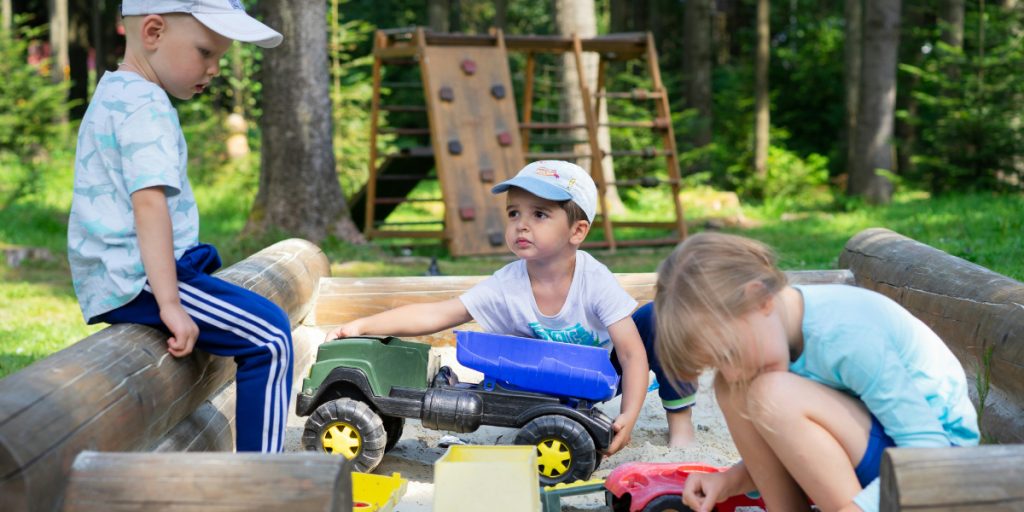
Sand, water, and planting areas. Even small touches can change how a space feels. Children tend to stay longer in these environments. They explore more. They interact differently.
In many of our builds, we integrate:
- Sandpits or bark areas
- Water play features
- Simple garden beds for sensory play
These align with what’s expected in natural playground design in childcare—less fixed outcomes, more open-ended use.
That doesn’t mean removing synthetic materials entirely. Astro turf, soft fall surfaces—they still play a role. That’s especially true when it comes to safety and maintenance. But pairing them with natural elements creates a more grounded space. Less artificial, more engaging.
Safety Without Over-Sanitising the Experience
Safety will always be part of the conversation in any playground installation for childcare centres. But there’s a point where too much control starts to limit development.
Children need some level of challenge. Not dangerous, but enough to push them slightly outside their comfort zone.
Climbing a little higher. Balancing longer than they think they can.
In many early learning centre outdoor design projects, there’s a shift towards risk-aware play. The idea is simple. Remove hazards, not opportunities.
That balance isn’t always easy to achieve. If you’re working through it, here is a guide on best practices for childcare fit-outs. This article basically covers how to approach safety without compromising engagement.
Multi-Use Spaces That Grow with the Centre
One thing that gets overlooked quite often is longevity. Outdoor spaces are usually built once, but used for years. Sometimes decades.
Centres change. Age groups shift. What works today might not work in two years.
That’s where flexibility comes in.
Open zones that can be repurposed. Equipment that isn’t fixed permanently. Layouts that allow for small adjustments over time.
Many childcare centres looking into outdoor play equipment are starting to prioritise this. It’s less about filling the space immediately but more about building something that can adapt.
A shaded area today might become a structured activity zone later. The design should allow that shift without needing a full redesign.
Storage and Practical Considerations
Not the most exciting part, but one that matters more than people expect. Outdoor spaces need proper storage. Equipment left out wears down faster. It also affects how the space feels. Clutter builds up quickly.
Built-in storage solutions tend to work best. Benches with compartments, discreet storage units, and weatherproof sheds that don’t interrupt the layout.
Storage keeps the space functional. And more importantly, usable.
This is something that often gets missed when discussing childcare centre playground ideas, but it plays a big role in day-to-day operations.
Designing with Supervision in Mind
Educators need to see what’s happening across the entire space.
Blind spots create problems. Large structures placed incorrectly can block visibility, which then affects how staff move around.
A well-designed layout makes supervision easier. Not harder.
It allows educators to monitor multiple zones without constantly shifting position. This is especially important in larger centres or those with mixed age groups.
Making the Space Feel Intentional
You can usually tell when a space has been planned properly.
It feels calm. Not empty, but not overcrowded either.
Every element has a role, even if it’s subtle.
That’s what we focus on in our work: creating spaces that feel considered, not just complete. If you’re planning a new build or upgrading an existing centre, you can explore how we approach projects from start to finish through our services.
Where to Go From Here
Outdoor spaces aren’t just an add-on to your centre. They play a direct role in how children move, behave, and settle into their day and how easily educators can manage routines. When the space works, everything else tends to follow.
If you’re reviewing your current setup, start simple. Walk through the space as if you were a child. Where would you go first? What would keep you there? Where does it feel lacking?
From there, the gaps become clearer.
And if you’re planning a new childcare fit-out, taking the time to get the outdoor area right early on will save you a lot later. Here at Mathiou Services, we work closely with centres to design and deliver outdoor environments that are practical, compliant, and built to last, without losing sight of how children actually use the space.
If you need a clearer direction, you can reach out through our contact page. We are always open to a conversation about what your space needs and how we can help make it work.